

Housing in Canada has been costly for a long time. The government has tried many things to fix this problem. One big change is extending the ban on non-Canadians buying homes until January 1, 2027. This ban started in 2022. It stops foreigners and businesses from purchasing residential properties with three units or less, like semi-detached homes and condos.
The government extended the ban for two more years as part of its plan to make housing affordable for Canadians. Foreign nationals and companies cannot buy small residential buildings, including semi-detached houses and condo units, during this time (1). The ban aims to help Canadians purchase homes without competition from foreign buyers.
According to the Department of Finance Canada, the ban aims to address concerns about foreign money driving up housing costs, particularly in major urban centers (3). In 2020, the share of the housing market owned by non-residents ranged from 2% to 6% in some provinces (2). However, experts have questioned the ban’s effectiveness, as in 2021, only around 1.1% of home sales in British Columbia involved a foreign buyer (2). While the ban is in place, some exceptions allow non-Canadians to acquire residential properties in certain situations, such as through divorce, separation, gift, or death (1).
Key Data Points on Canada’s Foreign Buyer Ban Extension and Housing Market (2023-2024)
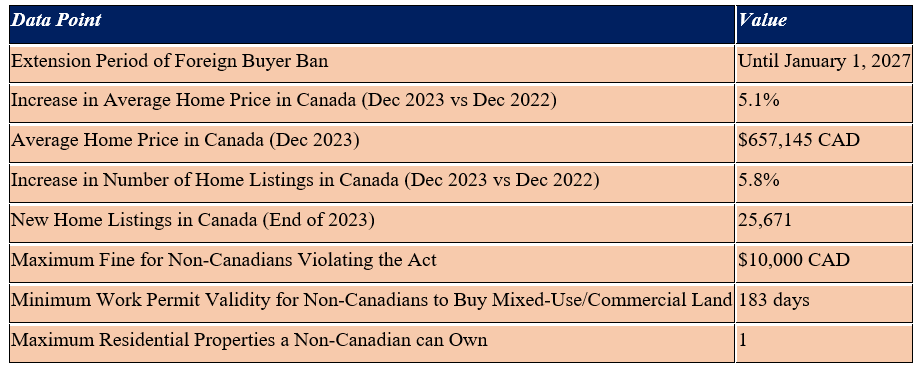
Also, people who aren’t Canadian citizens but have valid work permits can now buy mixed-use and business properties. They must meet certain rules though. Like having at least 183 days left on their work permit. And not having bought more than one home in Canada already (1).
Breaking the Act is seen as a crime. People who aren’t Canadian can be fined up to $10,000 CAD. And the court may order them to sell the home they bought (1). Companies or groups that break the rules may also face punishments. Their leaders and top officials could be held responsible too (1).
The government has taken several steps to make housing more affordable. One law removed taxes on new rental housing. Another program aims to help build over 101,000 new rental homes by 2031-32 (3). Additionally, the government set aside over $14 billion to construct 60,000 affordable homes and repair 240,000 existing ones. It also allocated $4 billion to encourage cities to change zoning rules and build housing faster (3).
Buying a home in Canada remains difficult. The Canadian Real Estate Agency (CREA) says the average home cost $657,145 CAD in December 2023. This is 5.1% more than in December 2022 (1). But CREA also reported a 5.8% increase in new homes for sale in that time. This added 25,671 more homes to the market (Source 1).
People looking to buy a home in 2024 must understand the new rules. Non-Canadians need to carefully review the document requirements (1). They should also get professional help to follow the extended foreign buyer ban correctly.
The government has a plan to help people buy their first home. This includes the Tax-Free First Home Savings Account. But the high costs of homes show more needs to be done. There is still an imbalance between housing supply and demand in Canada.