

Strong Rebound in Home Sales
Ontario’s housing market experienced impressive growth in February 2024. In this month, the home sales were rising amid low inventory. The latest data from the Ontario Real Estate Association (OREA) showed a massive 6.3% month-over-month increase in home prices. It was also reaching $873,207 – the highest level since June 2023.
Balanced Market Conditions
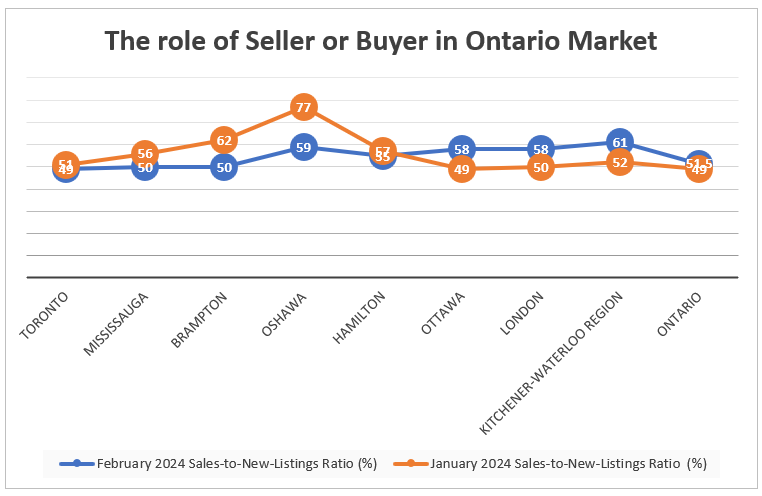
The sales-to-new listings ratio (SNLR) for February 2024 is 51.5%. It indicated a balanced market situation. Here buyer demand and seller supply are well matched. This balanced ratio stands for a change from last month’s relatively cool market conditions. It also indicated renewed interest from consumers.
Low Inventory Fuels Competition
Despite the increase in home sales, the Ontario housing market continues to struggle with low inventory. In February 2024, the number of active residents reached 32,776, up 18% from the previous year. But still, it was considered low by historical standards. This shortage of available homes creates competition among buyers, driving up prices.
Urban Market Dynamics
The size of the housing market varied across cities in Ontario. Ottawa (+3.1%), Brampton (+0.5%), Oshawa (+6.9%) and Toronto (+0.1%) saw year-over-year increases in home prices. However, markets such as Mississauga (-1.3%), Hamilton (-2.8%), Kitchener-Waterloo (-0.4%) and London (-0.7%) saw year-on-year declines in average prices of the previous year.
Population Growth Influences Demand
Population growth and population growth played an important role in the demand for housing in Ontario’s cities. In Toronto, with a population of 2,794,356 and a density of 4,428 people per square kilometre, house prices rose 0.1% year-on-year. On the other hand, In Brampton, the population has increased 10.6% since 2016, saw average house prices increased by 0.5%.
Affordability Challenges Persist
Despite the rebound, affordability challenges persist in the Ontario housing market. The average home price in the Greater Toronto Area (GTA) rose to $1,108,720, up 1.2% from a year ago. Mississauga ($996,259) and Brampton ($1,033,673) are among the most expensive markets in the region.
Mortgage Rate Impact
The minimum mortgage rate in Ontario is currently 4.54% for a 5-year fixed mortgage, through April 1. While mortgage rates have remained fairly stable, their impact cannot be ignored at an affordable price, Especially, for first-timers and established buyers.
Contribution of February month
Ontario’s strong housing market performance in February 2024 undoubtedly contributed to the overall growth of the province’s housing market. It included an average home price of $873,207, representing a 0.9% year-over-year increase. There was a comparable home price of $868,200, up 0.1% year over year. Statistics Ontario in February also demonstrated how resilient and desirable the city’s real estate market is.
And this increase in sales prices, coupled with a balanced market environment characterized by 51.5% sales and new listings. In addition, Ontario’s various urban sectors with higher price levels such as Ottawa, Brampton, Oshawa and Toronto highlight the broader nature of housing market dynamics.
Conclusion
As spring markets approach, industry experts expect market momentum to continue. It is expected to be fuelled by underlying demand and continued low inventories. But the long-term sustainability of this growth will depend on factors such as economic conditions, interest rate trends and the ability of the market. These are needed to meet the underlying supply -imbalances of demand.